
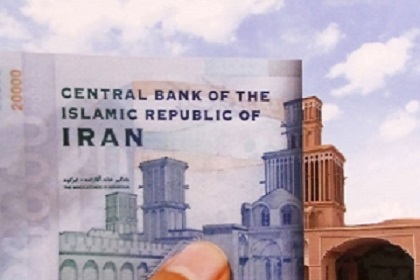
Planning a trip to Iran? One of the first questions many travelers ask is, “How does money work in Iran?” Unlike many other countries, Iran has a unique financial system that can surprise first-time visitors. International credit cards such as Visa, Mastercard and American Express generally do not work in Iran due to international banking restrictions. This means that tourists should plan to use cash during their trip. By the end of this Iran currency guide for tourists, you’ll know exactly how to manage your money confidently while traveling in Iran.
Money in Iran
Fortunately, managing money in Iran is much easier than many travelers expect. Exchange offices are widely available, cash is accepted almost everywhere, and the cost of traveling in Iran is often much lower than in many popular tourist destinations.
In this complete guide, you’ll learn everything you need to know before your trip, including:
Iran’s official currency
The difference between Rial and Toman
Whether you should bring US Dollars or Euros
Where to exchange money
Using ATMs and tourist debit cards
Safety tips for carrying cash
Frequently asked questions about money in Iran
Also Read : Iran Travel Tips 2026
Iran’s official currency
What Is the Official Currency of Iran? The official currency of Iran is the Iranian Rial (IRR). All banknotes, official prices, and government transactions are denominated in rials. There is no official symbol for this currency but the Iranian standard ISIRI 820 defined a symbol for use on typewriters (mentioning that it is an invention of the standards committee itself) and the two Iranian standards ISIRI 2900 and ISIRI 3342 define a character code to be used for it.
Rial vs Toman?
There is one important thing every visitor should know before traveling to Iran:
Although the official currency in Iran is Rial and all notes are printed in Iranian Rial, when talking money in Iran you may almost always hear the term “Toman” in daily life of locals; People rarely use the word “Rial” in everyday conversations.
The Toman is an old term and is no longer an official currency. Although the Toman is not the country’s official currency, it is the standard way that prices are quoted in shops, restaurants, taxis, hotels, and local markets. Despite this usage, amounts of money and prices of goods are virtually always written in Rials.
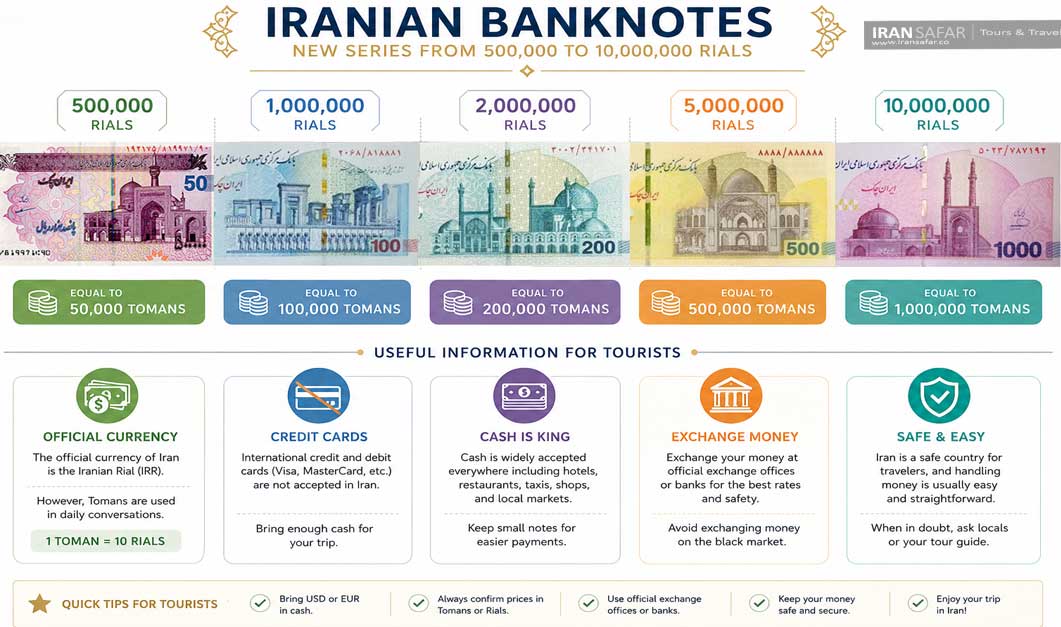
For this purpose, one “Toman” equals 10 Rials, so In order to get the price in Toman you can easily delete one zero of the amount and you have the price in Toman and vice versa. as an example if a taxi driver asks for 100.000 Tomans, by adding a zero you will know that the price is 1,000,000 Rials.
1 Toman = 10 Rials
For example:
500,000 Rials = 50,000 Tomans
2,000,000 Rials = 200,000 Tomans
10,000,000 Rials = 1,000,000 Tomans
Whenever someone tells you a price, don’t hesitate to ask:
“Is that Rial or Toman?”
Iranians are very familiar with this confusion and will usually be happy to clarify the amount.
Why Are Prices So Large in Iran?
You may notice that prices in Iran often contain many zeros. This is the result of years of high inflation, which has significantly reduced the value of the Iranian Rial over time.
To simplify everyday transactions, most Iranians use Tomans instead of Rials in daily conversations. In addition, the Iranian government has approved a plan to remove four zeros from the national currency. The reform aims to simplify financial transactions and accounting, although it will be implemented gradually over several years.
For travelers, this reform does not change the practical advice: always confirm whether a price is quoted in Rials or Tomans before making a payment.
Can Tourists Use Credit Cards in Iran?
One of the biggest surprises for international visitors is that Visa, Mastercard, American Express, and most other international bank cards do not work in Iran.
Due to international banking restrictions and snctions, Iran is not connected to global payment networks. This means you are not able to use foreign credit or debit cards to:
❌ Withdraw cash from ATMs
❌ Pay with international cards
❌ Book local services with international cards
Iran has its own electronic payment system. For this reason, tourists should bring enough cash for their trip, preferably in US Dollars (USD) or Euros (EUR). These currencies are widely accepted by exchange offices throughout Iran and can easily be exchanged for Iranian Rials.
Although international cards are not accepted, paying in Iran is still convenient. Cash is accepted almost everywhere, including hotels, restaurants, taxis, museums, shopping centers, and local markets.
Quick Tip
Before arriving in Iran, estimate your travel budget and bring enough cash to cover accommodation, transportation, meals, shopping, and any unexpected expenses.
✔️ Iran Safar travel agency offers tourist debit cards that can be loaded with Iranian Rials. These cards allow visitors to pay electronically in many shops and withdraw cash from local ATMs, making travel even more convenient for longer stays.
Where to Exchange Money in Iran?
In all the big cities in Iran there are some official money exchange places known as “Sarrafi” where you can exchange without worrying about getting ripped off.
Euro € and US Dollar $ can be changed easily in all these exchange offices but in big cities like Tehran you can even change currencies from other countries. The best place to exchange money in Tehran is Ferdowsi Sq , in Isfahan near royal square and in shiraz in city center near Karimkhan citadel where there are dozens of exchange shops.
We do not recommend you to refer to the banks to change the money otherwise you will loose your time and change your money with lower government rates.
Iran bank notes
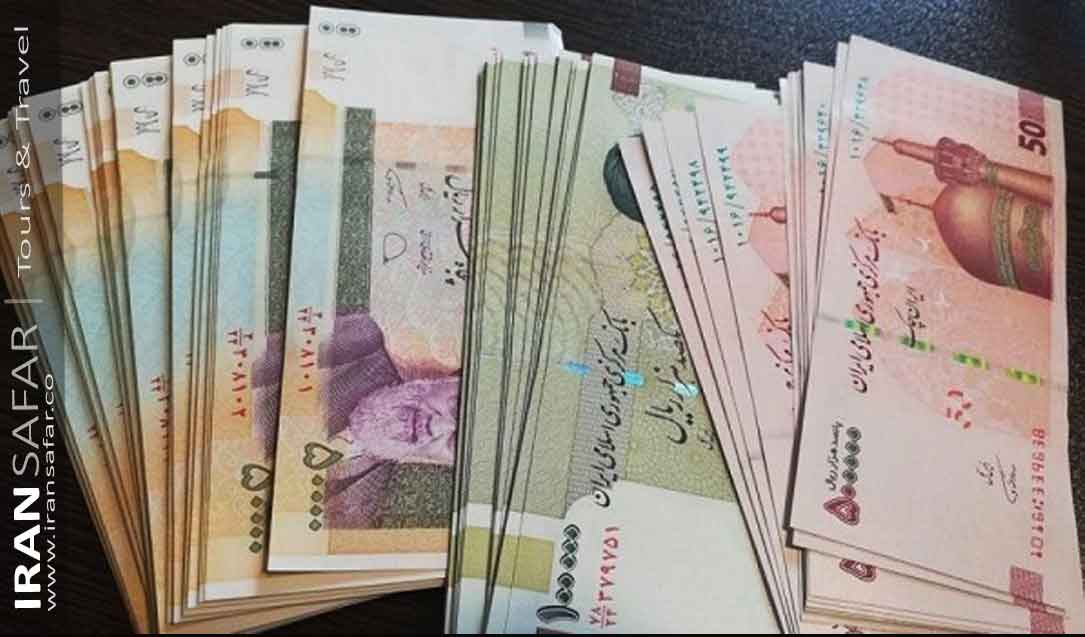
Iranian bank notes come in denominations of 5.000, 10.000, 20.000, 50.000, 100.000, 500.000, 1.000.000, 2.000.000, 5.000.000 and 10.000.000 Rials. Due to years of high inflation, Iranian coins are no longer used in everyday transactions and have virtually disappeared from daily circulation. Almost all payments are made using banknotes or ,local electronic payment methods.
Final Tips for Managing Money in Iran
Managing money in Iran is much easier than it may seem at first. As long as you understand the difference between Rials and Tomans, bring enough cash, and exchange your money at authorized exchange offices, you are unlikely to face any difficulties during your trip.
Before you travel, remember these key points:
- Bring US Dollars (USD) or Euros (EUR) in cash.
- International credit and debit cards generally do not work in Iran.
- Always ask whether a price is quoted in Rials or Tomans.
- Keep some small banknotes for taxis, local shops, and tips.
- Exchange your money at licensed exchange offices for the best rates.
With a little preparation, paying for hotels, restaurants, transportation, and shopping in Iran is simple and convenient, allowing you to enjoy your journey with confidence.
Comment (0)