
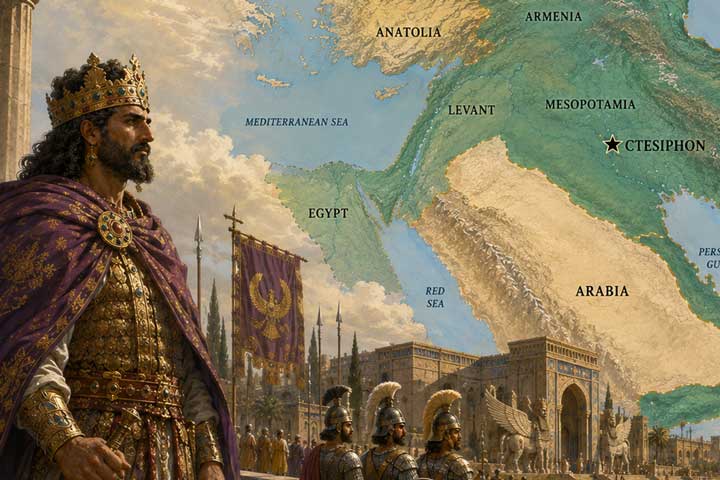
The Sasanian or Sassanid Empire (224-651 CE) was the last imperial government before the Arab invasion of Iran. This Sasanian dynasty, which ruled Iran from 224 to 651 AD, belonged to the Sassanid family. The founder of this dynasty was Ardeshir Babakan known as Ardashir I, who was able to establish this government by defeating Artabanus IV of Prthia. The Sassanid government had succeeded in uniting the country once again after the Achaemenids and creating a powerful empire. The Sassanid government, which ruled over a large part of West Asia, was the superpower of the world for almost 400 years, along with the Byzantine Empire.
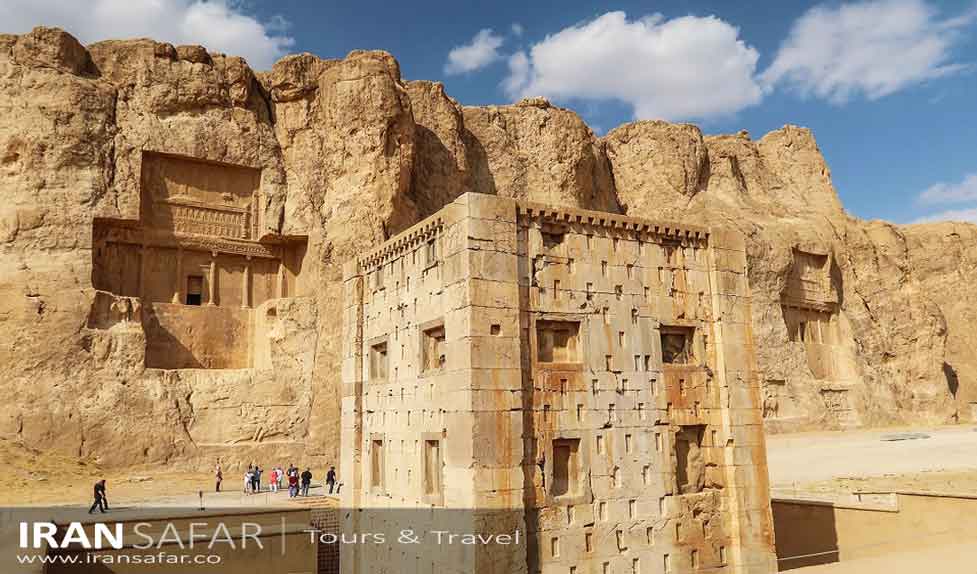 Naqsh-e Rustam, Marvdasht, Iran
The Sasanian Empire was the last in a series of Persian empires which had for centuries been seen as the rivals of Greco-Roman civilization. It was also the last before the coming of Islam changed the entire character of Persian or Iranian civilization.
In many ways, the Sasanian Empire already had one foot in this new medieval world, yet its self-image was firmly cast in the mould of ancient Iran and the Empire regarded itself as the true heir of that great Achaemenid Persian Empire destroyed by Alexander the Great hundreds of years earlier.
In some ways Sassanian Iran also had more in common with Hindu India than subsequent Muslim Iran. People were divided into “castes” with an Iranian warrior elite of supposed “Aryan” origin dominating others of inferior birth. The domain of the Shahanshah or Sassanian King of Kings become identified with Iranshahr, the Land of the Iranians and of the Zoroastrian religion. There were many Iranians outside the Sassanian Empire and many non-Iranians within, yet this ethnically based attitude was deep rooted and would, to some extent, even survive the egalitarian spirit of Islam. Like their Roman rivals the Sassanian Iranians were trapped within an archaic view of the world. While the Romans believed that they were the natural masters of civilization, the Iranians believed that their King was the divinely ordained master of all kings.
The Character of the Sasanian Empire
Though the Sasanians modeled themselves on the ancient Achaemenid Persian Empire, their state was really very different. Like Romans the Sasanian Empire relied heavily on slave labor, but at the same time Sassanian merchants ranged far and wide, gradually ousting the Romans from the lucrative Indian Ocean trade routes. It was also a time of increased metallurgical production so that Iran earned a somewhat undeserved reputation as the “ََArmory of Asia”. In fact, the main Sassanian mining centers were on the fringes of the Empire, in Armenia, the Caucuses and above all Transoxiana. The extraordinary mineral wealth of the Pamir mountains on the eastern horizon of the Sassanian Empire led to a legend among the Iranian-speaking Tajiks which is still told today. It was said that when God was making the world he tripped over the Pamirs, dropping his jar of minerals which spread across the region.
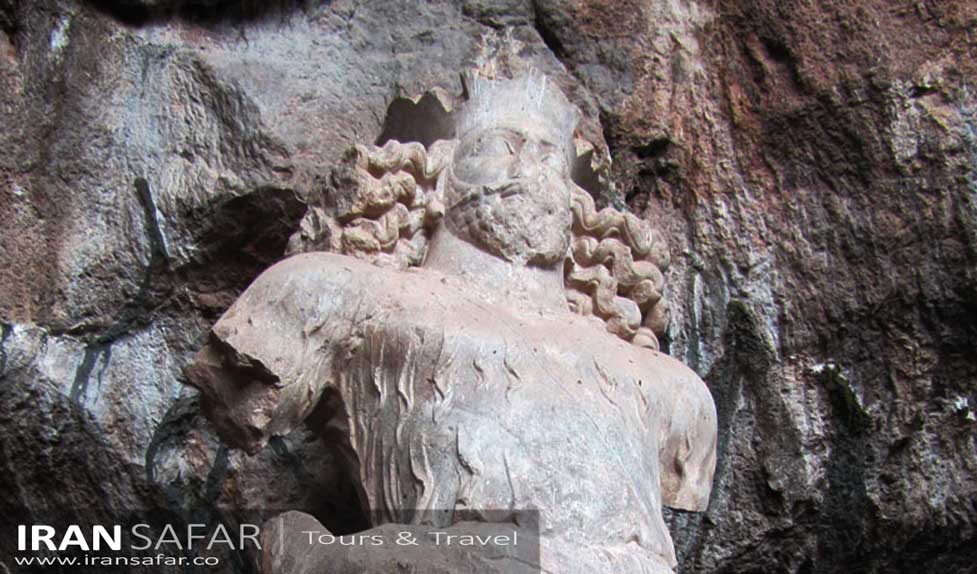 Shapur I statue, Shapur cave, Kazerun, Iran
I. Sassanid Emperor
At the heart of the Sasanian Empire sat the Emperor (Shahanshah) – a figure of huge power and prestige. The previous Parthian dynasty, which drove Alexander the Great‘s successors out of Iran, had adopted a Hellenistic Greeks deification of kingship. This, when added to ancient Iranian cults, placed the ruler between heaven and earth as a link between his subjects and the great god Ahura Mazda. Around the ruler stood his family, held together by clan loyalty and ancestor veneration. No Sassanian books on government have survived but the 9th century “Book of the Crown” is based on a Sassanian prototype. It emphasizes the splendor of a Divinely ordained ruler, the passivity of his subjects, and makes very few concessions to concepts of justice, generosity and compassion. Such abstract ideas had to await a later series of Muslim Persian and Arabic “Mirrors for Princes”.
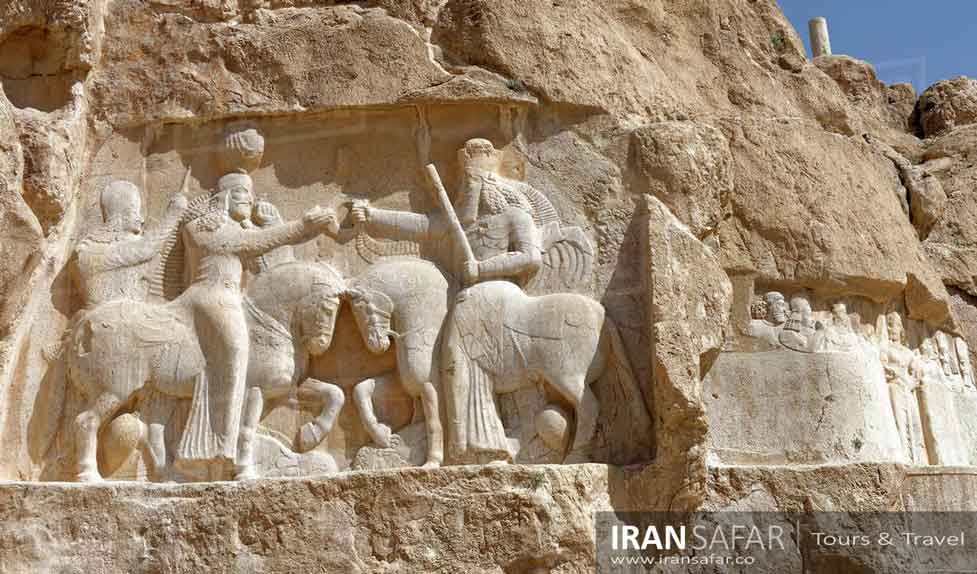 Investiture scene of Ardshir I, Mardasht, Shiraz
The Kings Who Shaped the Sassanian Empire
Four rulers who played an important role in the rise, expansion, transformation, and decline of Sassanian Persia.
Ardashir I
Ardashir I founded the Sassanian Empire in 224 CE after defeating the last Parthian ruler. He built a strong central state and began a new era in Persian history.
Shapur I
Shapur I expanded the empire and fought several major wars against Rome. His victories are still remembered in impressive Persian rock reliefs.
Khosrow I
Khosrow I strengthened the army, improved taxation and government, and supported learning and culture. His reign became one of the high points of Sassanian Persia.
Khosrow II
Khosrow II led the empire to remarkable territorial expansion. However, long wars with Byzantium weakened the empire and contributed to political instability.
II. Class Division in Sasanian Society
The division of social classes in the Sassanid period is based on the same as stated in the Avesta, the four Sassanid classes were:
A– Nobles & Highborn
B– Clerics (asronãn)
C– Warriors (arteshtarãn)
D– Administrative staff (dabirãn)
F– Common people (villagers or Wastrioshãn)
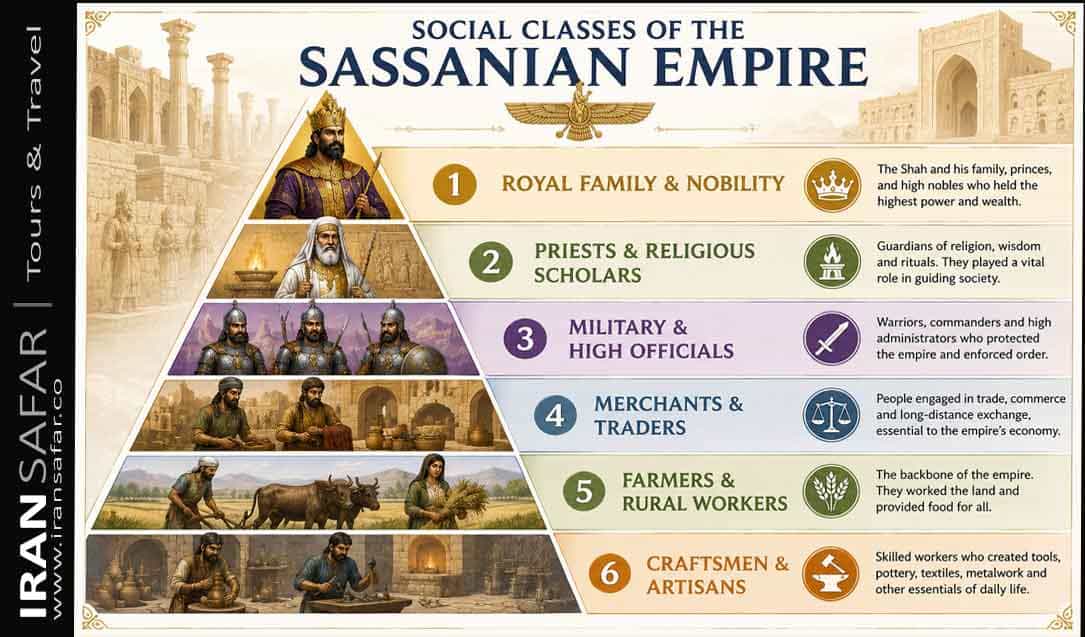
In a realistic point of view, we will find that the society of that time was divided into two general classes. The upper class, which included the royal family, the old families of local rulers and military officials; they were called by the name of Bozorgan meaning Lords or Grandee.
And the lower class; which was the mass of people and included: farmers, artisans and craftsmen. But what is obvious in the Sasanian social structure is that the people at the bottom of this pyramid were not able to raise their class and they and their descendants would remain in the same class forever. It is a gross class discrimination that questions the nature of their humanitarianism to the extent that promotion from the lower class to the upper class was impossible.
III. Sasanian Empire Religion
The declaration of Zoroastrianism as the official religion created a type of unity in the religions in Iran. During the Sassanid period, Zoroastrian religion was declared an official religion by the government, and later Zoroastrianism was divided into different sects.
During the Sassanid era, religion gave legitimacy to the kings and the government. The people would be completely obedient to the king, although this kind of attitude had led to religious tyranny to some extent so that the people would avoid this closed atmosphere and sometimes turn to other religions or superstitions. Before the Sassanids, there was no official religion in Iran and the tribes of Iran each had their own religion.
During this period, the people of Iran had a strong religious orientation. It was on this basis that the Sassanid governments considered themselves dependent on religion, and played a role in keeping religious ceremonies alive. As the Zoroastrian fire temples (Atashkdeh) were still lit years after Islam, and their effect is still present everywhere in Iran now, the religion was alive in all the places under the influence of the Sassanids.
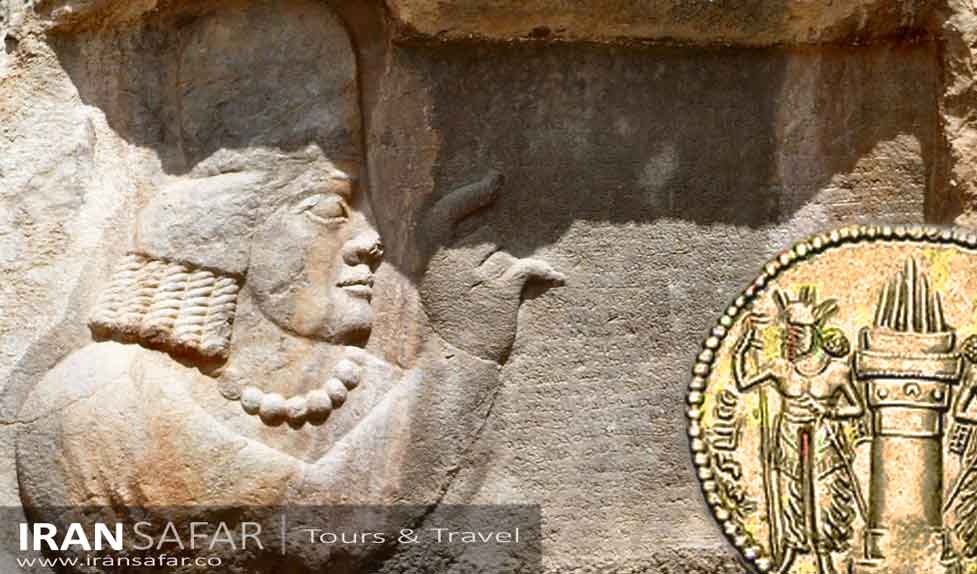 Relief of Kartir – the supreme priest, Neqsh-e Rostam, Iran
IV. Sasanian script, Literature and Education
The most famous scripts used during the Sassanid era are Ashkani Pahlavi script and Sassanid Pahlavi scripts. These scripts were adapted from the Aramaic script, and all administrative correspondence, historical literary writings and books of Sassanid period were written in this script.
In those days, education was only reserved for Bozorgan (Grandees) and the common people were deprived of education and the benefit of science and knowledge.
Jondishapur Academy also known as Jondi Shapur university was one of the important centers of science, education and research, and many scientists and polymaths were engaged in research there. King Anushiravan Sassanid sent some people to India to acquire knowledge. He also warmly accepted and supported some Greek philosophers who had fled to Iran due to the narrow-mindedness and bigotry of the Roman Christians.
V. Roman – Persian Wars
The Roman wars are a series of wars that started in 54 BC with the invasion of Roman commander Marcus Licinius Crassus who played a key role in the transformation of the Roman Republic into the Roman Empire. Crassus invaded Iran during the reign of Parthian king Orod II and continued until the end of the Sassanid era. These wars ended with the rise of Islam and the Arab invasion, by which time both empires were weakened by the long lasting conflicts. Although these wars lasted for 700 years, the borders remained largely unchanged. These battles were a kind of tiring tug-of-war between the two empires: the cities, fortresses and provinces of both sides were continuously conquered, looted, handed over and destroyed.
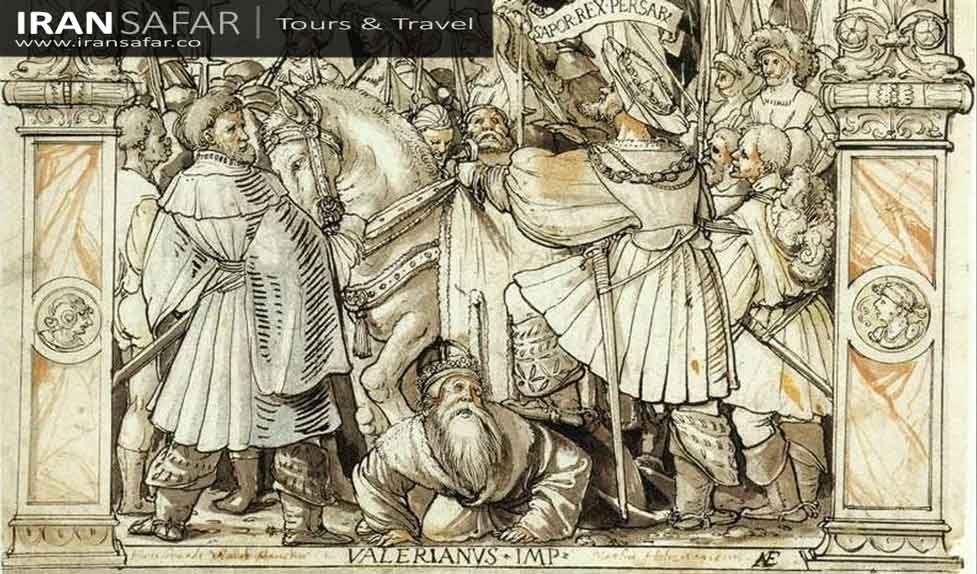 Shapur I victory scene and humiliation of Roman Valerian
None of the two empires had the power and strength to mount a long-term campaign in the enemy’s land and far from their borders. Both sides camped outside their borders in the enemy’s land, but sooner or later the balance between them was always maintained.
Shapur I Sassanid was the second emperor of the Sasanian Empire. He was chosen as the regent during the lifetime of his father Ardeshir I. During his father’s reign, he participated in many battles as the viceroy of Iran and found a high position with Ardeshir I. Shapur I of Sassanid was crowned in 240 AD.
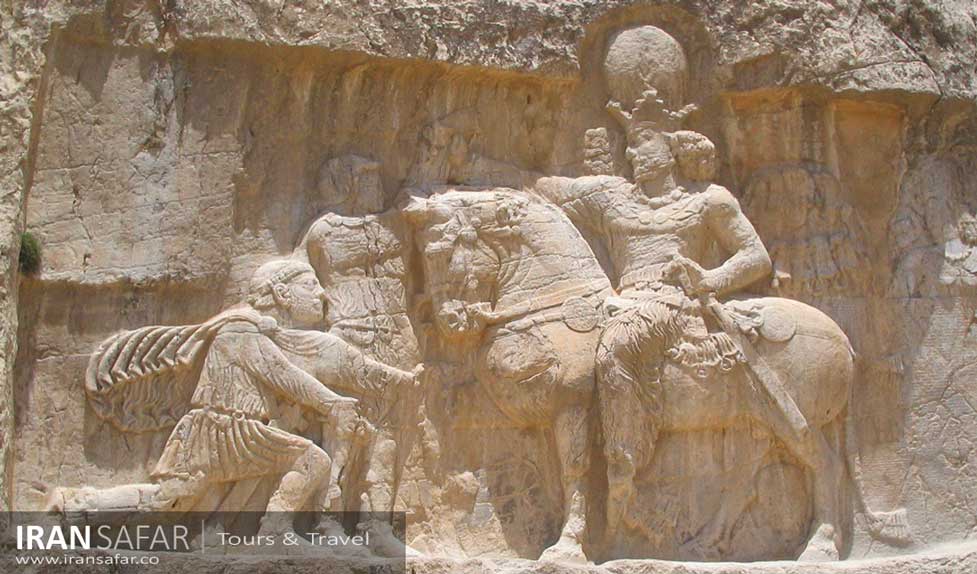 The victory scene of Shapur I, Marvdasht, Iran
In 238, while his father was still alive, Shapur defeated the Romans who invaded Iran and conquered a strong fortress between Iran and Rome. The army of Gordianus III – the young emperor of Rome – was so beaten that the emperor himself was killed. A little later, the king Ardeshir also died and Shapur became the “Emperor of Iran” and continued the war with Romans. Philip the Arab, the Roman emperor came to frustration, and apologized to Shapur and paid a compensation of five hundred thousand dinars for the peace proposal.
In the third war, he defeated Romans with great difficulty. One of the consequences of the war between Iran and Rome was the conquest of Armenia. The acquisition of Armenia inflicted a great defeat on Rome. Sassanid Shapur I succeeded in defeating Valerian in 254 AD.
VI. The Territory of the Sassanian Empire
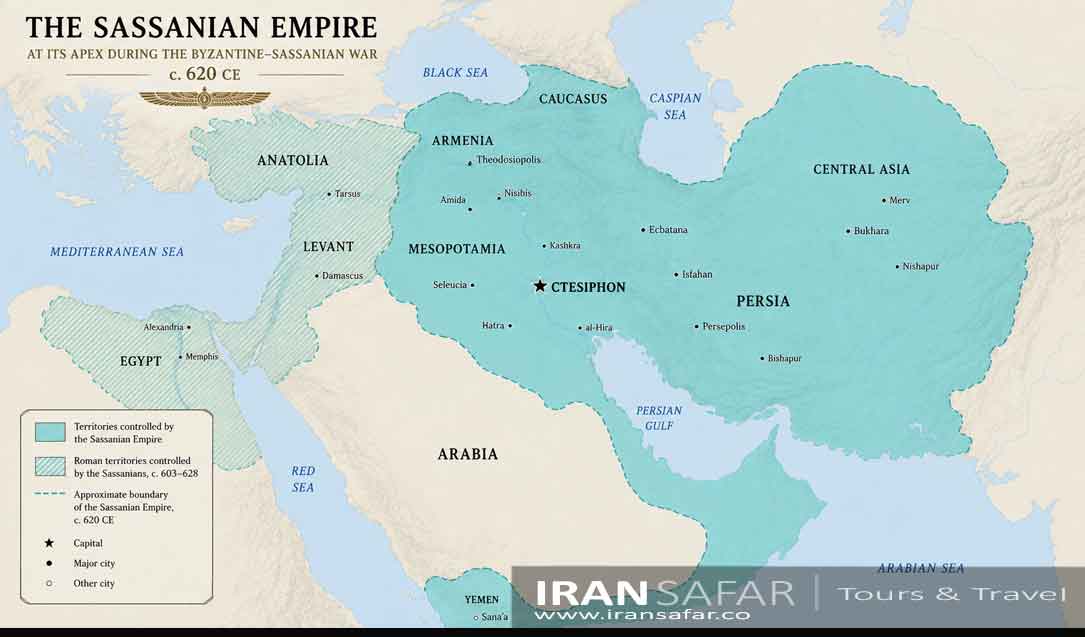
At its height, the Sassanian Empire stretched far beyond the borders of modern Iran. Its territories and areas of influence reached across much of present-day Iraq, the Caucasus, Central Asia, Afghanistan, and parts of the Arabian Peninsula and Anatolia. This enormous territory connected very different landscapes—from the mountains of the Caucasus and the Iranian Plateau to the fertile plains of Mesopotamia and the trade routes of Central Asia. Controlling these regions gave the Sassanians access to important agricultural lands, commercial routes, and strategic passes, helping Persia become one of the major powers of the ancient world.
VII. Sasanian Historical Monuments
Many historical monuments have been left from the Sassanid era, including palaces, hunting lodges, fire temples, religious monuments, inscriptions, reliefs and a statue in a cave.
1
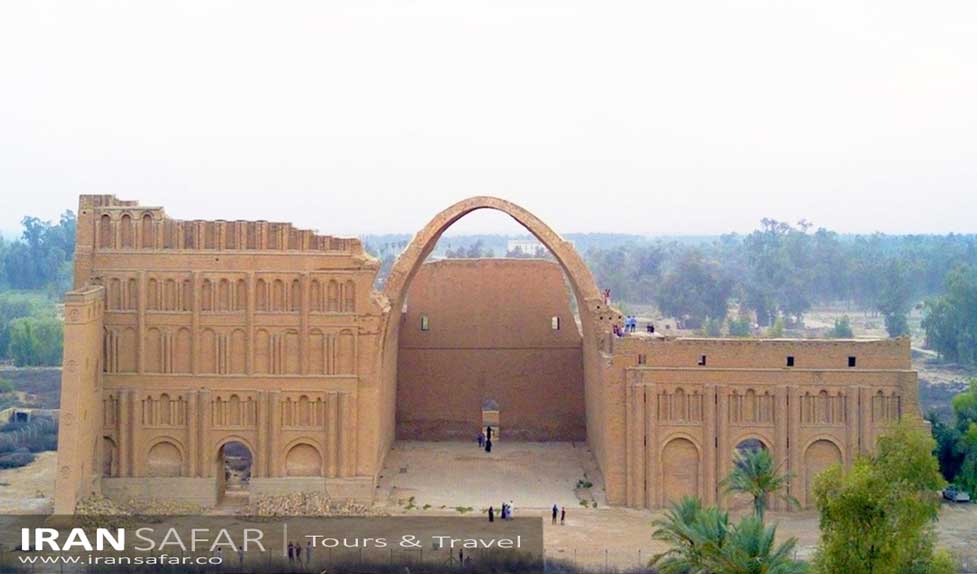
Ctesiphon – Sasanian Empire Capital
Taq Kasra or Khosrow’s Arch also referred to as Arch of Ctesiphon is one of the most beautiful historical attractions in the Middle East. Located in Iraq, this site is considered one of the most famous tourist attractions of the country.
Present Iraq was a part of ancient Iran under Sasanians and was much later separated from Iran. Taq Kasra is currently located in Diyala province, at a distance of 40 kilometers from the southeast banks of the Tigris river. In the past, this building was located at the entrance of a city called Ctesiphon. The neglect of the Iraqi people to this Iranian building and their lack of care has caused wear and damage to this ancient Sassanid site.
2
Bishapur
The ancient city of Bishapur is one of the most valuable historical cities left from the Sasanian Empire. The site is located near the city of Kazerun, Fars province of Iran. According to an inscription, the city was founded in 266 AD by Shapur I (241-272). Iranians and Roman captives cooperated in building the city in this area of a good climate. Roman engineering and art has influenced the architecture of Bishapur, and it is easy to see the similarities in the style of the two nations.
The eastern mosaic porch, Anahita Temple, Palace known as Valerian’s palace, Hall of Audience, a Bath and a Caravanserai are among the most important historical monuments. The historical remains in nearby Tang-e Chogan and many monuments in this ancient city undoubtedly attract the attention of countless visitors.
3
Ardashir’s Palace- Firuz Abad
Firuzabad was the first capital of the Sasanian Empire that still exists and offers amazing attractions. The ancient buildings of the Sasanian era are located in this town located 110 km south of Shiraz. Ardeshir’s Palace in Firuzabad is one of the most important and valuable historical sites in this ancient city.
The scales of Ardeshir’s Palace is about 104 x 55 m and consists of three parts. It has a courtyard with two attached porches and halls, a high Iwan and three domed halls inside. These are the three main parts of the Palace. In the architecture of Ardeshir Babakan Palace, the important and glorious materials of the era, which were plaster and tiles, have been used and had doubled the beauty of the palace.
This monument is the first Sassanid building that has a porch and a dome. The masters of architecture and artists of the Sassanid era used semi-cut stones in the construction of different parts of the building and showed off their style and techniques. Beautiful and eye-catching stucco decorations are other pure Iranian skills that are displayed in this building.
4
Qal’eh Dokhtar – Firuzabad
Qal’eh Dokhtar, also known as Dezh Dokhtar meaning “The Maiden Castle” is a castle built by Ardashir I, the founder of the Sasanian Empire in 209 AD.
Located 6 km from Firouzabad, on a slope in the heart of the mountains, Ghal’eh Dokhtar was a stronghold and served as an important obstacle for the enemies to cross the “Tangab Gorge”. General architectural features of the palace inside this castle, in comparison with Ardashir palace in Firouzabad plain, show that the Maiden Castle was founded during Ardeshir I‘s wars with Parthians before his final victory over the last Parthian king, Ardavan IV (Arthabanus IV) in 224 AD.
The main fortifications of Qal’eh Dokhtar include an outer wall that extends over a sloping cliff with an overall shape of a trapezoid. These fortifications started from the lower part of the “Tangab Gorge” and extended to the highest part of the mountain where the inner castle is located. The geometrical multi-level layout of the inner palace is in complete contrast to the non-geometrical mode of the castle itself, which is based on the natural shape of the mountain.
Read: Famous Castles of Iran
5
Naqsh-e Rostam – Mardasht
The Sasaninan Monarchs who considered themselves to be worthy successors to the Achaemenids, revived the art of rock carvings to immortalize the most important events in their history.
Near 8 centuries later than Naqsh-e Rostam was founded, Sassanian monarchs Ardeshir I and his son Shapur I, commissioned rock panels consecrated to their glory; they revived the Achaemenid principle and had their works executed in prestigious localities. Thus, on the cliffs of this necropolis, at the foot of the grand Achaemenid tombs of Darius, Xerxes, Artazerxes I, and Darius II, Sassanians created Bas-reliefs showing their investiture or triumphal scenes.
Read: Full Guide to Naqsh-e Rostam
6
Taq-e Bostan
The Persian term Taq-e Bustan, meaning ‘arch of the garden’ is the name of one of those enchanting places so loved by the Iranians in which nature and Man worked together to create a master peace. Laid out around a pool surrounded by large trees that provide refreshing shade, this site a few miles from Kermanshah is dominated by precipitous rock faces, at the base of which ancient sculptors expressed their artistry. Taq-i Bustan is the place where the Sassanian sovereigns, in obedience to an ancient water cult dedicated to the goddess Anahita, built a series of extremely interesting rock-cut monuments.
Here, however, instead of investiture or triumphal scenes carved on the rock, there are artificial grottoes entirely hewn out of the rock.
Read: Taq-e Bostan, a legacy from Sassanids
Sassanid Archaeological Landscape of Fars Region
UNESCO World heritage
Eight archaeological sites located in three different areas of Fars Province in south Iran including Firuzabad, Bishapur and Sarvestan have been recently registered as world heritage sites. These fortresses, palaces and city plans date back to the Sasanian Era , which stretched across the region from 224 to 651 CE. Among these sites is Qaleh Dokhtar at Firuz Abad, the capital built by Ardashir Babakan, as well as Bishapur, a city and architectural structures of his successor, Shapur I. The archaeological landscape reflects the optimized utilization of natural topography and bears witness to the influence of Achaemenid and Parthian cultural traditions and of Roman art, which had a significant impact on the architecture of the Islamic era.
Read: Sassanid Archaeological landscape of Fars
Symbols of Sassanian Persia
The Sassanian Empire left behind more than palaces, battles, and royal inscriptions. Its visual world was filled with symbols that communicated power, faith, kingship, and social status. Crowns, fire altars, royal emblems, winged motifs, and richly decorated coins were not simply artistic details. They formed a visual language through which the Sassanian state presented its identity.
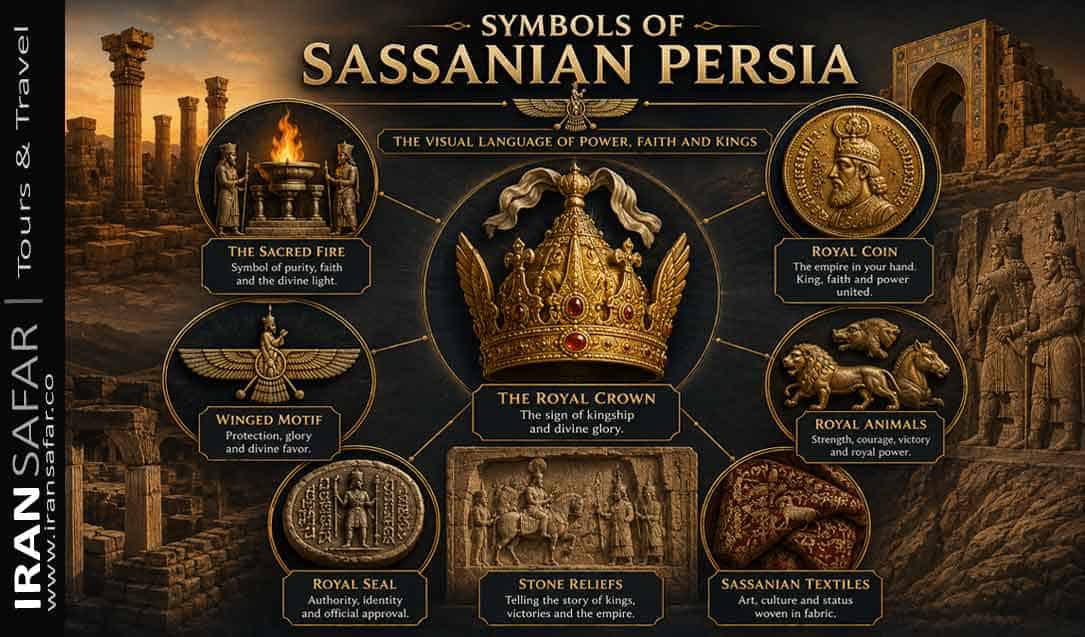
👑 The Crown: A King’s Identity in Gold
Perhaps no Sassanian symbol was more personal than the royal crown. Unlike a simple European-style crown, Sassanian royal headgear could be highly distinctive, with different rulers adopting their own shapes, ornaments, wings, globes, ribbons, and other features.
A king could often be recognized by his crown alone.
This made the crown more than a sign of wealth. It was almost a visual signature of the ruler. On coins, rock reliefs, textiles, and ceremonial scenes, the crown helped establish the king’s identity and his position at the center of the empire.
🔥 The Sacred Fire
Fire occupied an important place in Zoroastrian religious tradition and became one of the most recognizable elements of Sassanian visual culture.
The fire altar appears repeatedly on Sassanian coins, often accompanied by attendants standing on either side. Its presence was remarkable because the same symbol appeared on an object used throughout the empire as an everyday representation of royal authority: the coin.
For an ordinary person, therefore, a Sassanian coin was not merely money. It could also carry a miniature representation of the religious and political world of the empire.
🪽 The Winged Motif
Winged imagery appears frequently in the artistic vocabulary of ancient Persia. During the Sassanian period, winged forms could be incorporated into royal and ceremonial designs, reflecting ideas of protection, glory, sovereignty, and divine favor.
One should be careful, however, about automatically identifying every winged Persian figure as the modern symbol known as the Faravahar. The famous modern interpretation of the Faravahar developed through a much longer history, while Sassanian artists used a variety of winged and celestial motifs with different meanings.
That distinction makes Sassanian symbolism even more fascinating: the images we recognize today do not always carry exactly the meanings we give them now.
🦁 Royal Emblems and Animals
Animals were another important part of Sassanian visual culture. Lions, boars, horses, bulls, birds, and other creatures appeared in royal art, textiles, seals, metalwork, and monumental decoration.
These animals were not chosen randomly. Strength, courage, victory, fertility, protection, and royal power could all be expressed through animal imagery.
The result was an artistic language in which a single creature could communicate an idea without a single word being written.
🪙 Coins: The Empire in the Palm of Your Hand
Perhaps the most fascinating Sassanian “symbol” is something people often overlook: the coin.
Sassanian rulers used coins to project their image across a vast territory. A typical coin could combine the ruler’s portrait, his distinctive crown, royal titles, religious imagery, and the sacred fire altar.
Think of it as an ancient form of mass communication.
A farmer in a distant province, a merchant traveling along a trade route, or a soldier receiving his pay could all encounter the same carefully designed image of the king.
The Sassanian Empire did not have newspapers, television, or social media—but its coins traveled remarkably far.
🏛️ A Visual Language of Power
Taken together, these symbols reveal something important about Sassanian society. The empire was not held together only by armies and administrators. It also depended on a powerful visual identity.
The king, the sacred fire, the crown, the royal emblem, and the imagery of animals and warriors all contributed to a message that was repeated across monuments, coins, seals, textiles, and ceremonial objects:
Persia was powerful, ordered, ancient, and protected by a sacred tradition.
That may be one of the most interesting things about Sassanian art. Its symbols were designed not merely to be beautiful, but to make people see the empire itself.
The Fall of the Sasanian Empire
The Sassanid era is one of the most important and influential parts of Iran’s history. During this period, the fourth great Iranian dynasty arose, which was equal to its predecessors in terms of glory and power. This dynasty colain 651 AD during the time of Yazdgerd III due to the Arab invasion. Although this empire was defeated in the war, there are many reasons behind this failure. In the following, we will examine these causes.
◉ Causes of the fall of the Sassanids
Although Yazdgerd III is the last king of the Sassanid dynasty, the reasons for the defeat of the Iranians against the Arabs go back to the time of Khosrow II also known as Khosrow Parviz. As one of the most powerful Sassanid kings, Khosrow had actions that caused the foundation of this historical failure.
1- Long wars with the Roman Empire
During these wars, which lasted for about 20 years, many times Iran could end the war by accepting peace from the Romans, but Khosrow II’s desire to conquer continued the conflicts.
2- Khosrow II’s defeat by Bahram VI
During a battle, Khosrow was defeated by Bahram Chubin (Bahram VI), who was a Sassanid commander with a Parthian family background dreaming of kingdom.
After this defeat, Khosrow took refuge in the Roman Empire and Bahram was crowned as King Bahram VI. He ruled for almost a year until Khosrow received help from the Byzantine emperor Mauricius – in exchange for accepting the transfer of some cities from Iran to Rome – and recaptured the Iranian capital. This event caused the direct intervention of Rome in the administration of the Iranian court.
3- Heavy taxes
Considering the quadrupling of the royal treasury during the time of Khosrow and the existence of a constant war, it is quite clear what a heavy tax was collected from farmers and merchants.
4- The Battle of Zoghar and the defeat of Khosrow
This civil war happened as a result of the killing of Numan bin Munzer, the king of the Lahimi Christian dynasty in Hira. This group of Arabs were loyal to the Sassanids. After Numan was killed by Khosrow Parvez, the Iranian army was defeated in the war against the Arab clans 6- The riots after the assassination of Khosrow Parviz: Khosrow Parviz was murdered by his son Shiroviah and Shiroviah sat on the throne for a few months. He died of the plague. Between the death of Khosrow Parviz and the accession of Yazdgerd III, ten members of this family came to the kingdom and were killed by an insider. These anarchies and bloodshed caused the weakening of the pillars of the Sassanid dynasty, and the Arab attack was able to quickly destroy the weak king and break this 400-year-old dynasty.[/su_expand]
Although the collapse of the Sasanian Empire was sudden and unexpected, the Sassanian heritage remained important in Iran, if not always beneficial. The early 7th century saw defeat in a war of epic proportions against the Romano-Byzantines. From a Mediterranean perspective this conflict marked the true “end of antiquity”. For Iran it paved the way for the Muslim Arabs to make the first successful invasion from the west since the days of Alexander the Great.
Paradoxically, perhaps, this crushing of the Sasanians led to what has been described as “The Golden Age of Persia”. It would also see eastern and western Iran truly united for the first time in history. Some aspects of Sassanian civilization would survive in Scmirechye, south of Lake Balkash, as late as the 12th century. Meanwhile the brilliant civilization of Classical Islam, the world of the Caliphs as still recalled in the legendary “Thousand and One Nights”, owed a great deal to its Sassanian predecessor. This was particularly true in military matters. The first Arabic book on tactics and army organization is believed to have been a translation, now lost, of a Persian work written for Ardashir back in the 3rd century AD.
Sasanian Empire Timeline
Ardashir Babakan (Papkan)
Ardashir Babakan (Papkan), also known as Ardeshir I, king of Persis, revolts against Artabanus IV Parthian and founds the Sasanian Empire.
Fall of the Parthians
Sasanians overthrow the Parthians.
Reign of Ardashir I
Reign of Ardashir I, who made some reforms such as making Zoroastrianism state religion.
Reign of Shapur I
Reign of Shapur I (son of Ardeshir) – Sassanian empire reaches its zenith.
Invasion of Armenia
The Sassanid Empire invades the Kingdom of Armenia.
Capture of Roman Emperor Valerian
Shapur I defeats and captures the Roman emperor Valerian.
Coronation of Hormizd I
Coronation of Hormizd I.
Coronation of Bahram I
Coronation of Bahram I.
Execution of Mani
The execution of Mani by influential Zoroastrian high priest Kartir.
Coronation of Bahram II
Coronation of Bahram II.
Coronation of Hormizd II
Resignation of Narseh; Coronation of Hormizd II.
Reign of Shapur II
Reign of Shapur II; descendant of Shapur I.
Invasion of Armenia
The Sassanid Empire invades and destroys several cities in the kingdom of Armenia.
Coronation of Shapur III
Coronation of Shapur III.
Division of Armenia
Roman emperor Theodosius I and Shapur III of Persia agree to formally divide Armenia between the Eastern Roman (Byzantine) Empire and the Sasanian Empire.
Armenian Marzpanate
Persia rules one half of Armenia as the Marzpanate, that is with marzpan viceroys.
Battle of Avarayr
Battle of Avarayr between Armenian forces and those of the Sasanian Empire.
Treaty of Nvarsak
The Treaty of Nvarsak is signed between Persia and Armenia giving the latter a greater political autonomy and freedom of religious thought.
Siege of Edessa
Kavad, king of the Sasanian Empire, unsuccessfully besieges Edessa.
Coronation of Khosrow I
Coronation of Khosrow I.
Belisarius and the Byzantine–Persian Conflict
Belisarius defeats the Persians to the east of the Byzantine Empire – End of conflict between Persia and Byzantine Empire (the one that started in 524).
Siege of Edessa
Khosrow I, king of the Sasanian Empire, unsuccessfully besieges Edessa.
Conquest of Yemen
Conquest of Yemen.
Death of Khosrow I
Death of Khosrow I and the Coronation of Hormizd IV.
East Rome Defeats Sasanian Persia
East Rome defeats Sasanian Persia.
Reign of Yazdegerd III
Reign of Yazdegerd III, the last king of the Sasanian Empire.
Murder of Yazdegerd III & End of the Sasanian Dynasty
Murder of Yazdegerd III; end of the Sasanian dynasty; Establishment of Islamic Empire.
Comment (0)